
Introduction
Birbal’s Quick Thinking in English with Moral is an engaging Akbar and Birbal story about solving a difficult problem with calmness and intelligence. When two villages begin arguing over water from the same canal, Emperor Akbar must find a fair solution before the quarrel becomes worse. Many ministers offer complicated suggestions, but none of their ideas help both villages. Birbal listens carefully, studies the situation, and uses a simple demonstration to reveal the real cause of the dispute. This child-friendly story shows that even a big problem can be solved when we think clearly and treat everyone fairly.
The Story
One summer, the kingdom of Emperor Akbar faced unusually hot weather.
For many weeks, dark clouds appeared in the sky, but no rain fell. The ponds slowly dried up, and the water level in the wells became lower each day.
Farmers worried about their crops.
Animals gathered near the remaining water sources.
Akbar ordered his officers to distribute water carefully and help the villages most affected by the heat.
One morning, two village leaders entered the royal court.
The first was Hari Singh from Sundarpur. The second was Karim Khan from Noorabad.
They bowed before the emperor, but they did not greet each other.
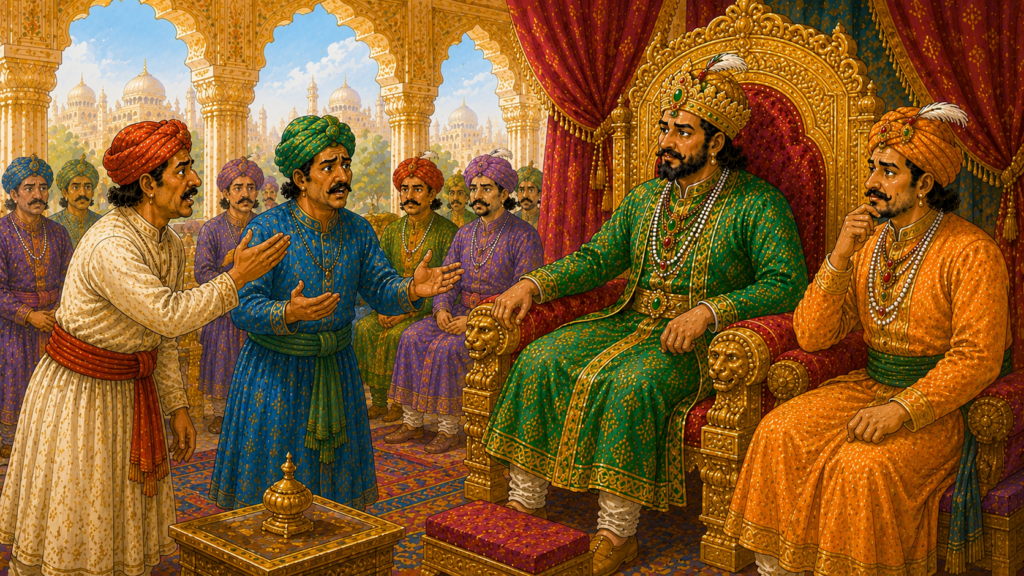
Akbar immediately noticed their angry faces.
“What has brought both of you to my court?” he asked.
Hari Singh stepped forward.
“Your Majesty, the people of Noorabad have blocked the canal. They are taking all the water before it reaches our fields.”
Karim Khan shook his head.
“That is not true! Sundarpur receives plenty of water. They want even more and are blaming us.”
“You are wasting the water!” cried Hari Singh.
“And you are being greedy!” replied Karim Khan.
The royal court became noisy.
Akbar raised his hand.
“Silence!”
Both village leaders lowered their heads.
Akbar looked serious.
“The canal belongs to the kingdom. Its water must be shared fairly. Why has this dispute begun now?”
Hari Singh answered, “The canal flows through Noorabad before reaching Sundarpur. For the last two weeks, very little water has reached our village.”
Karim Khan replied, “We have not changed anything, Your Majesty. We take only what we need.”
Akbar turned to his ministers.
“How should this matter be solved?”
One minister stood up.
“Your Majesty, divide the canal into two smaller canals.”
Another minister disagreed.
“That will take months. The crops will dry before the work is completed.”
A third minister suggested, “Send soldiers to guard the canal.”
Karim Khan looked worried.
“Soldiers cannot measure every drop of water.”
Another courtier proposed building a large dam, but the royal engineer explained that such a project would require much time and money.
Akbar listened to every suggestion.
None seemed simple, quick, and fair.
At last, he turned to Birbal.
“Birbal, you have been quiet. What do you think?”
Birbal smiled gently.
“Your Majesty, I would like to visit the canal before giving my answer.”
Akbar agreed.
“Go today. We must solve this problem quickly.”
Birbal travelled with both village leaders and a small group of royal officers.
They first reached Noorabad.
The canal entered the village through a wide stone opening. Farmers used narrow channels to direct water towards their fields.
Birbal walked slowly along the canal.
He looked at the water, the banks, the field channels, and even the mud near the edge.
Karim Khan said, “You can see that we have not blocked it.”
Birbal nodded but did not answer.
He then followed the canal towards Sundarpur.
As they walked, the water became shallower.
About halfway between the villages, Birbal suddenly stopped.
A large tamarind tree had fallen near the canal during a storm.
Its thick roots had broken part of the canal wall. Mud, stones, leaves, and branches had collected beneath the water.
The blockage was difficult to see from above.
Only a narrow stream of water was passing through.
Hari Singh stared at it.
“So Noorabad did not steal our water?”
Karim Khan looked equally surprised.
“And Sundarpur was not lying about receiving less water.”
Birbal examined the broken wall.
“The argument began because both villages saw only their own side of the problem,” he said. “Neither village checked the whole canal.”
The officers immediately began clearing the branches and mud.
However, Birbal noticed another problem.
The broken wall was causing water to escape into an empty patch of land.
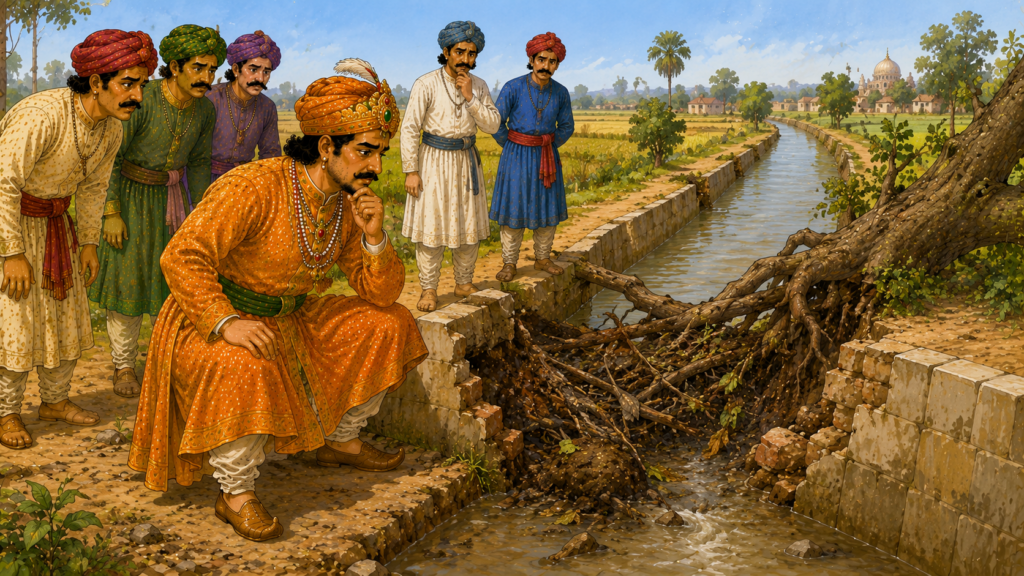
“We must repair this quickly,” he said.
Karim Khan asked, “But how can we rebuild the wall today? The stone workers are far away.”
Birbal thought for a moment.
Then his eyes fell upon several large grain sacks lying on a farmer’s cart.
“Fill those sacks with sand,” he instructed.
The villagers looked confused, but they obeyed.
Birbal arranged the heavy sandbags against the broken section of the canal wall. He placed them in overlapping rows so the water could not easily pass between them.
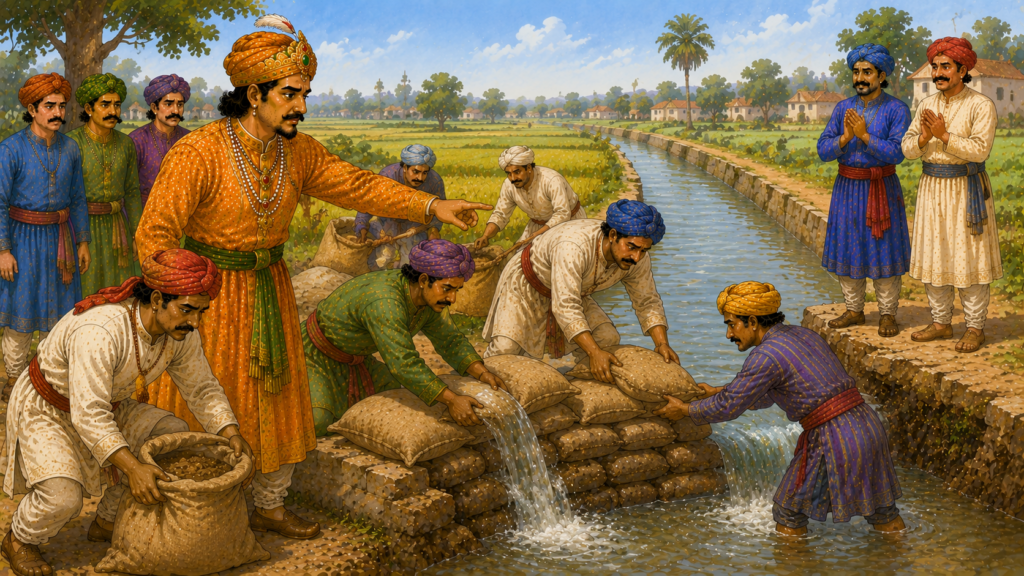
Soon, the leaking water slowed.
The canal began filling again.
More water flowed towards Sundarpur.
Hari Singh smiled with relief.
“Our fields will receive water again!”
But Birbal had not finished.
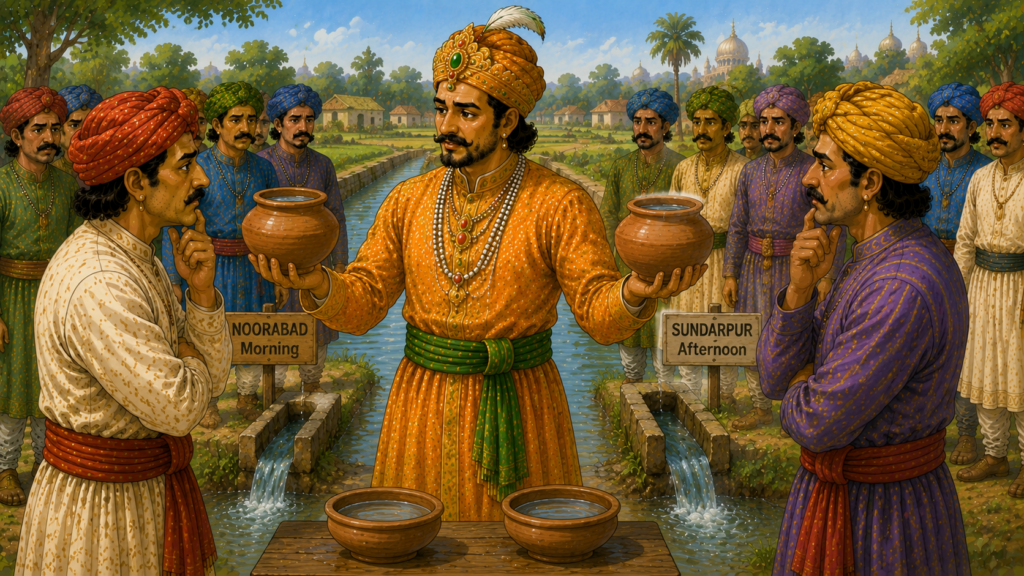
He asked the villagers to bring two identical clay pots.
He placed one pot beside the main channel leading to Noorabad’s fields and the other near the channel flowing towards Sundarpur.
“Why do we need these pots?” asked Karim Khan.
Birbal replied, “They will help everyone understand how the water should be shared.”
He filled both pots from the canal until they contained equal amounts of water.
Then he poured one pot into Noorabad’s field channel and the other into Sundarpur’s channel.
“Water should be distributed according to the number of fields and the needs of the crops,” Birbal explained. “Not according to which village lies closer to the canal’s beginning.”
He asked the royal officers to mark the channels clearly and create a daily schedule.
Noorabad would receive water during the first half of the day.
Sundarpur would receive water during the second half.
During the night, water would be stored in a shared pond for animals and household needs.
Hari Singh looked at Karim Khan.
“We accused your village without checking the canal.”
Karim Khan replied, “And we became angry instead of helping you find the cause.”
The two leaders joined their hands respectfully.
“Let us repair the canal together,” said Hari Singh.
Karim Khan smiled.
“Yes. The water belongs to all of us.”
The following morning, Birbal returned to the royal court with both village leaders.
Akbar asked, “Did you discover who was taking the water?”
Birbal placed two water clay pots before the throne.
“No one was stealing it, Your Majesty.”
The ministers looked surprised.
Birbal explained how the fallen tree had damaged the canal and how hidden mud and branches had blocked the water.
He also described the sandbag repair and the new water-sharing schedule.
Akbar smiled.
“So the real problem was not greed. It was a lack of proper observation and communication.”
“Exactly, Your Majesty,” said Birbal. “When people become angry too quickly, they stop searching for the truth.”
Hari Singh and Karim Khan bowed.
“We have agreed to maintain the canal together,” they said.
Akbar praised them for ending their quarrel.
He then turned to Birbal.
“Many people suggested expensive projects and strict punishments. You solved the matter using careful observation, sandbags, and two clay pots.”
Birbal smiled.
“A big problem does not always need a big solution, Your Majesty. Sometimes it only needs a calm mind and a clear look at the facts.”
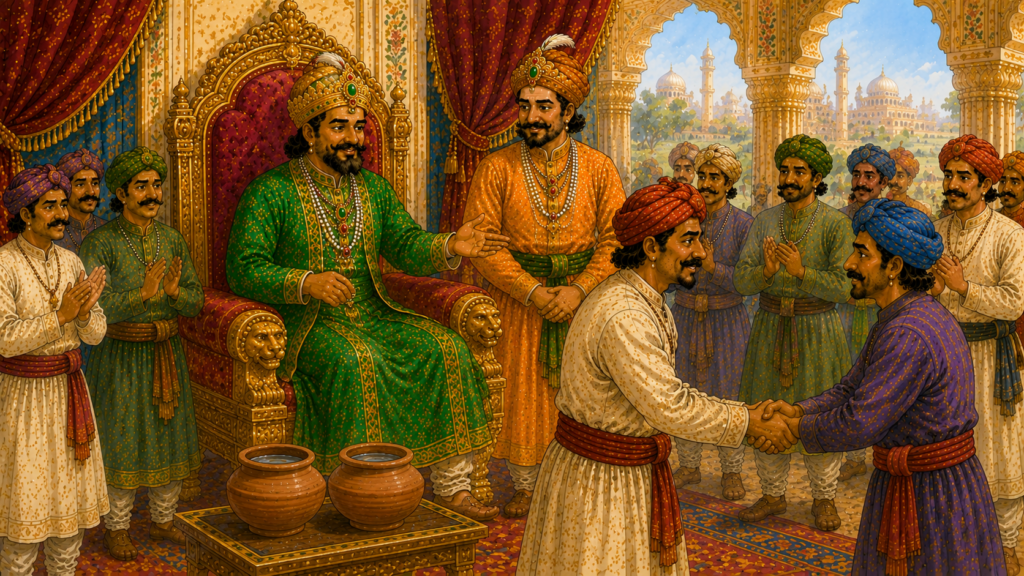
Everyone in the court applauded.
From that day onward, the people of Sundarpur and Noorabad cleaned the canal together every month. They also met regularly to discuss water use before disagreements could begin.
The canal continued to serve both villages, and the friendship between them became stronger than before.
Moral of the Story
A calm mind and careful observation can turn a big problem into a simple solution. We should understand the facts before blaming others.
What Kids Learn
- Think calmly before making a decision.
- Do not blame others without knowing the facts.
- Careful observation helps us find the real problem.
- Sharing resources fairly prevents arguments.
- Teamwork can solve difficult situations.
- Simple ideas can sometimes be the most effective.
Short Summary
Two villages argue because very little canal water is reaching one of them. Each village blames the other, so Emperor Akbar asks Birbal to investigate. Birbal discovers that a fallen tree has damaged and blocked the canal. He uses sandbags to stop the leak and creates a fair water-sharing schedule with two clay pots. The villages apologise and agree to maintain the canal together. Birbal teaches everyone that quick thinking, observation, fairness, and cooperation can solve even a big problem.
FAQs
1. What problem did Birbal solve in the story?
Birbal solved a water dispute between two villages that depended on the same canal.
2. Why was less water reaching Sundarpur?
A fallen tree had damaged the canal wall, and mud, stones, and branches were blocking the flow.
3. How did Birbal repair the canal quickly?
He asked the villagers to fill grain sacks with sand and arrange them against the damaged canal wall.
4. How did Birbal divide the water fairly?
He created a schedule that gave each village water for half the day and used a shared pond for other needs.
5. What is the moral of Birbal’s Quick Thinking?
The moral is that calm thinking, careful observation, and fairness can solve difficult problems.
Read More Stories

Introduction
The Hanuman Sloka for Courage Meaning in English is one of the most inspiring prayers...
Tenali Ramakrishna stories are like moral stories that teach us ways to deal with life challenges with...

Once in a deep forest, there was a special goat with shiny golden hair. He was big and strong, like a...