
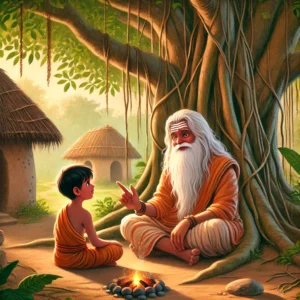
This story is also known as The Story of Sage Uddalaka and Shvetaketu – Tat Tvam Asi Explained for Kids.
Long, long ago, in ancient India, there lived a great sage named Uddalaka. He lived a simple life in his peaceful forest ashram. People came from faraway places to learn from him, for he was known not only for his wisdom, but also for his calm and loving nature.
Sage Uddalaka had a son named Shvetaketu. From childhood, Shvetaketu was sharp, curious, and eager to learn. When he turned twelve, his father sent him to live with a respected guru so that he could study sacred knowledge properly.
For many years, Shvetaketu studied the Vedas, rituals, chants, and scriptures. He worked hard and learned many things. After twelve long years, he returned home as a young man of twenty-four, full of confidence.
As soon as he met his father, Shvetaketu said proudly,
“Father, I have learned everything. I know the Vedas, the rituals, and the shastras.”
Sage Uddalaka listened quietly. He loved his son deeply, but he sensed something troubling—pride had quietly entered Shvetaketu’s heart.
The sage gently asked,
“My dear son, have you learned about that which cannot be seen, cannot be heard, and cannot be touched?”
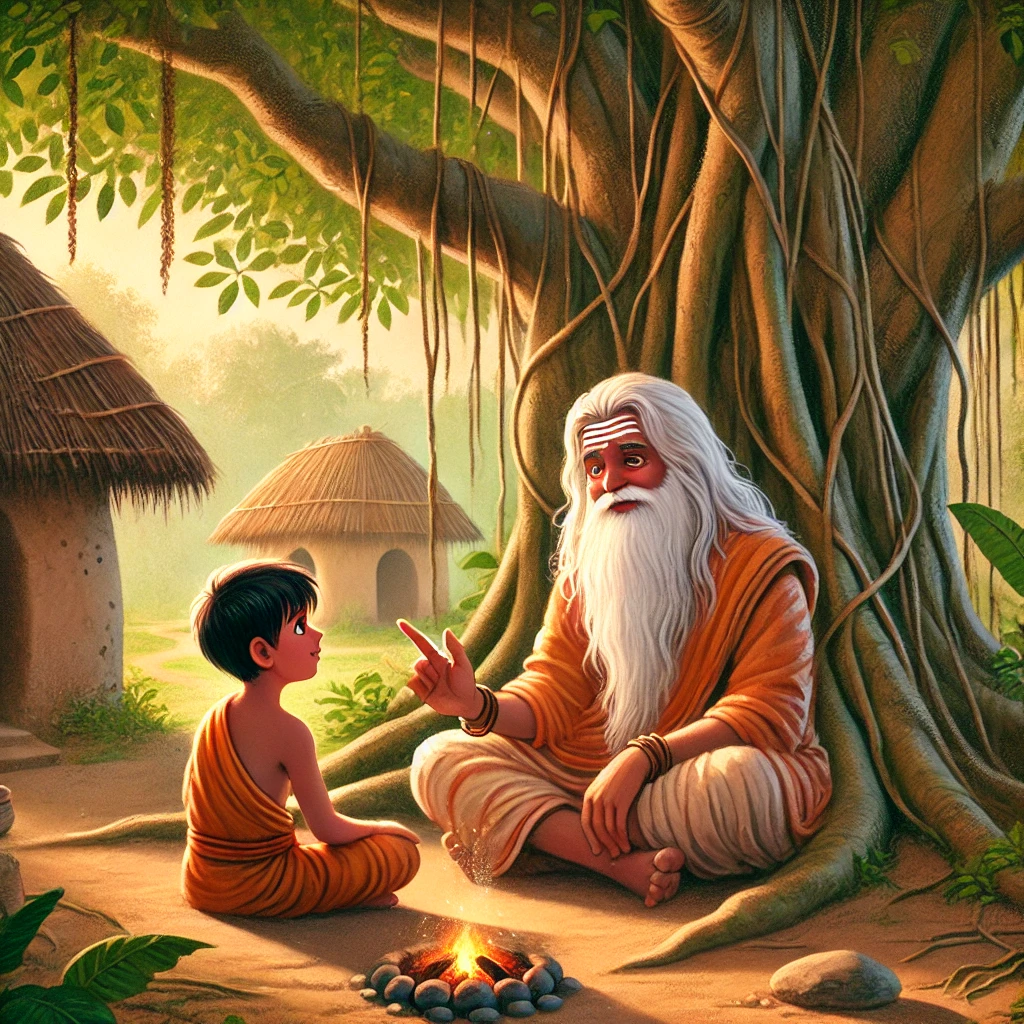
Sage Uddalaka and Shvetaketu story for kids – Tat Tvam Asi Explained for Kids.
Shvetaketu looked surprised. “What do you mean, Father?”
Uddalaka smiled and replied,
“If you understand the nature of clay, then you understand every pot made from clay, even if you have never seen each one. Tell me, do you have such deep understanding?”
Shvetaketu paused. His pride slowly melted. He bowed his head and said honestly,
“No, Father. Please teach me.”
Sage Uddalaka nodded.
“Bring me a fig fruit from the tree,” he said.
Shvetaketu brought a ripe fig.
“Now break it open,” said the sage.
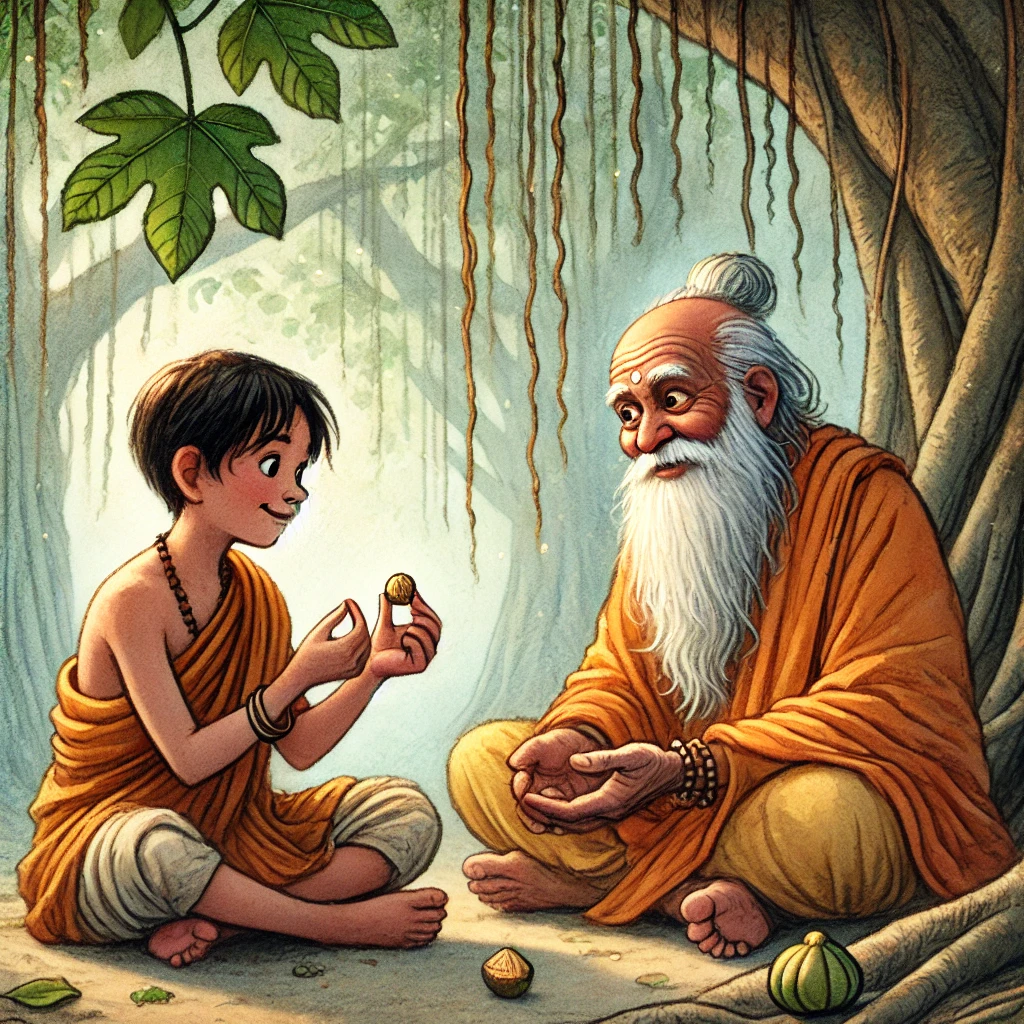
Inside were many tiny seeds.
“What do you see?” Uddalaka asked.
“Small seeds,” Shvetaketu replied.
“Take one seed and break it,” his father instructed.
Shvetaketu tried carefully. After some effort, he broke the seed open.
“What do you see inside now?” asked Sage Uddalaka.
Shvetaketu stared closely and said in surprise,
“Nothing at all.”
The sage said softly,
“From this tiny seed that looks empty, a huge fig tree grows. That unseen essence holds great power. What looks like nothing is actually everything.”
Shvetaketu listened in wonder.
The next lesson was just as simple.
Sage Uddalaka asked his son to pour some salt into an earthen pot filled with water. After doing so, the sage said,
“Let us continue tomorrow.”
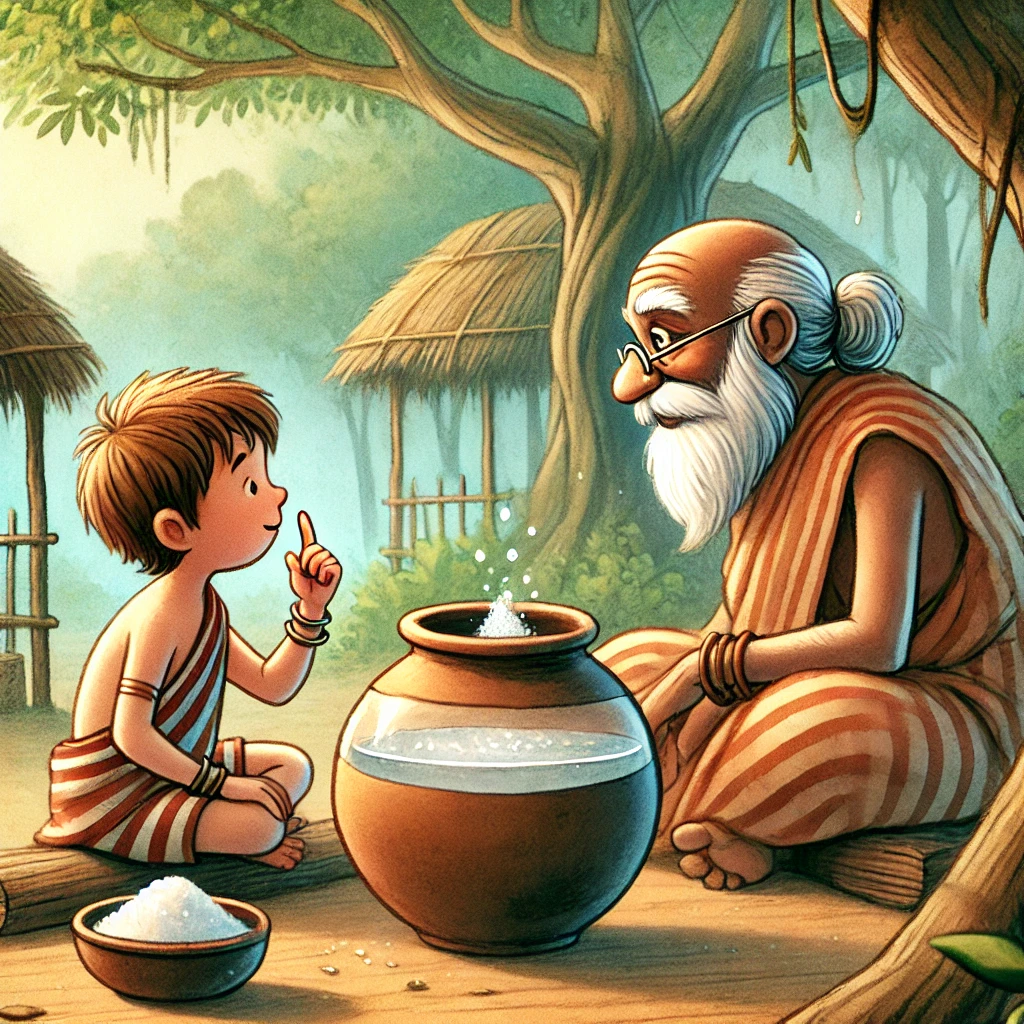
The next morning, Uddalaka asked,
“Can you take the salt out of the water?”
Shvetaketu shook his head. “No, Father. It has dissolved.”
“Then taste the water from the top,” said the sage.
“It is salty,” replied Shvetaketu.
“Now taste from the middle and the bottom.”
“It is salty everywhere,” said the son.
Uddalaka smiled and asked gently,
“Has the salt disappeared?”
“No,” Shvetaketu replied. “It is still there, even though I cannot see it.”
The sage placed his hand lovingly on his son’s shoulder and said,
“In the same way, the most important part of you lives inside you. It cannot be seen, but it is always present.”
Then he spoke the great truth:
“Tat Tvam Asi.”
“You are that. You are part of the Supreme Truth. Understanding this is the true purpose of life.”
Shvetaketu felt calm and peaceful. He finally understood that real wisdom is not about showing knowledge, but about knowing the truth hidden within.
Thus, through love and patience, a wise sage taught his son the greatest lesson of all.
Moral for Children
Not everything important can be seen with our eyes.
Truth, love, and goodness live quietly inside us.
Our parents and teachers—especially wise guides like sages—help us discover the best part of ourselves.
Uddalaka related story: https://storysangam.com/mythology-stories-the-dedication-of-uddalaka-aruni-2/

Introduction
Bhagavad Gita Sloka 2.47 Meaning in English is one of the most famous and inspiring verses...
Easy Sanskrit Slokas with Meaning in English for Kids are a wonderful way to introduce children to Indian...
Introduction
The Krishna and the Butter Thief Story in English is one of the most loved stories from...

There are some stories that stay with us forever. The story of Lord Rama is one such story. It is not...
The Ugadi Magic Bowl Story is a heartwarming moral story for children that celebrates the joy and meaning...

Mythology Story for Kids tells us that God looks at our heart, not our status, wealth, or knowledge.
Long...