
The Foolish Thief in English with Moral is an exciting Akbar and Birbal story that teaches children an important lesson about honesty and the consequences of wrong doing. In this story, a valuable necklace mysteriously disappears from a wealthy merchant’s home. Several servants become suspects, but no one knows who the real thief is. Emperor Akbar asks Birbal to solve the mystery. Instead of using force, Birbal comes up with a clever test that reveals the truth. Read on to discover how a foolish thief trapped himself and learned that crime never pays.
The Story
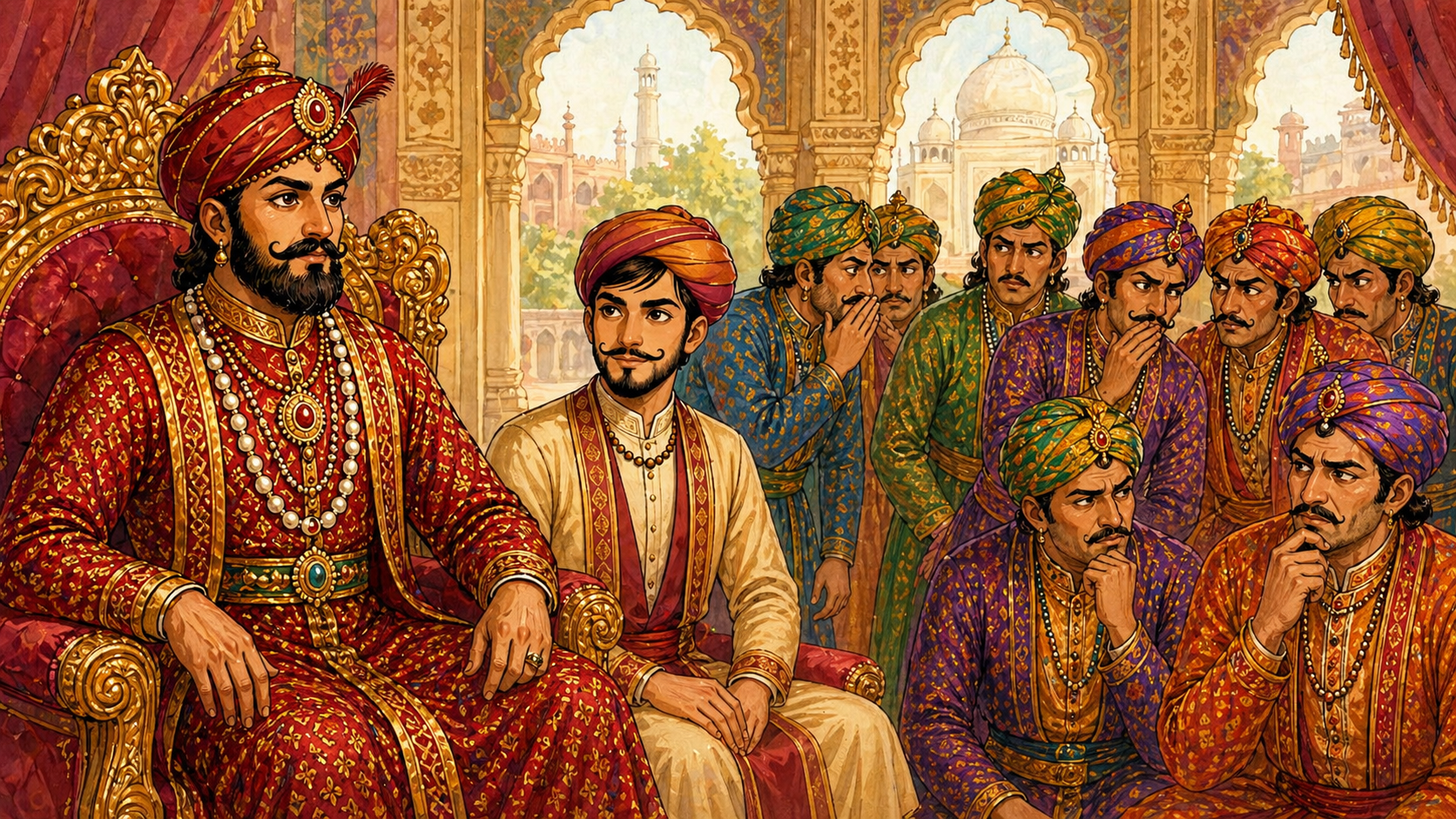
One morning, Emperor Akbar was holding court in his magnificent palace.
The royal hall was filled with ministers, merchants, soldiers, and visitors from across the kingdom.
Suddenly, a wealthy merchant named Raman entered the court.
He looked worried and upset.
After bowing respectfully, he said, “Your Majesty, I need your help.”
Akbar nodded.
“What troubles you, merchant?”
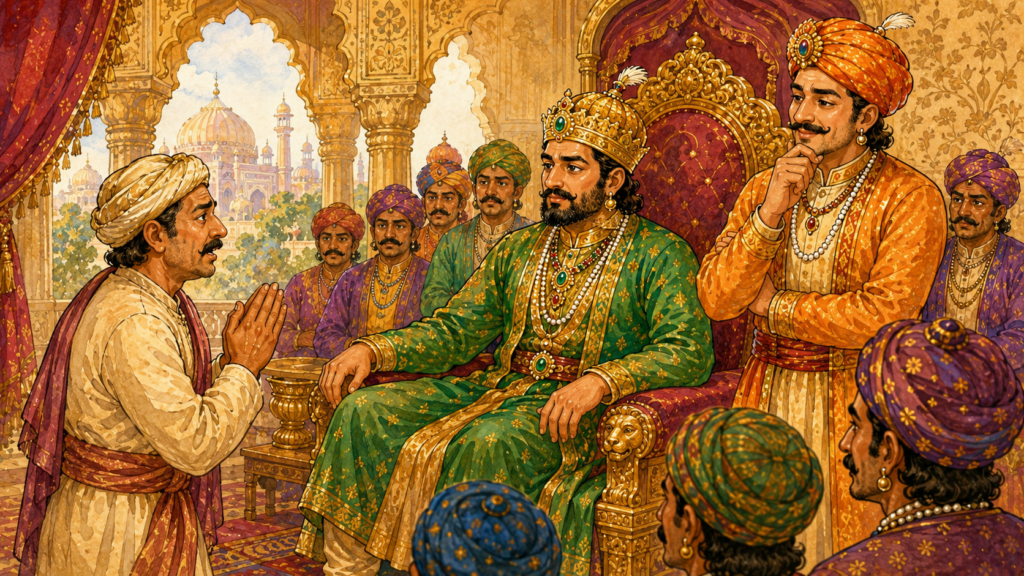
“My precious pearl necklace has been stolen,” Raman replied sadly. “It disappeared from my house last night.”
The court became silent.
“A pearl necklace?” asked Akbar.
“Yes, Your Majesty. It has been in my family for many years.”
Akbar immediately turned to Birbal.
“Can you solve this matter?”
Birbal smiled.
“I will certainly try, Your Majesty.”
The merchant explained that only four servants had been inside the house the previous evening.
All four servants were brought before the royal court.
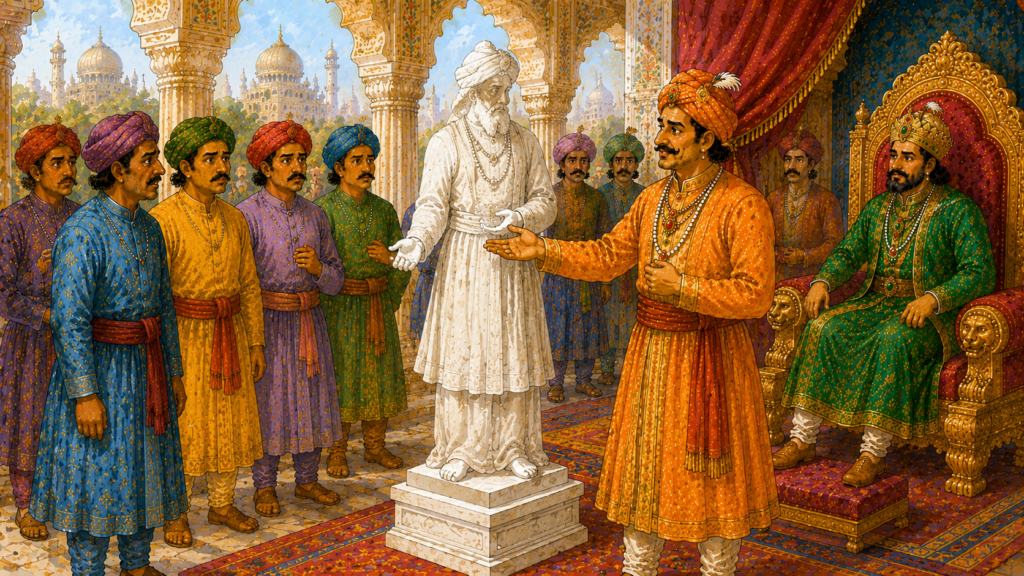
Akbar looked at them carefully.
“Did any of you steal the necklace?”
One by one, they shook their heads.
“No, Your Majesty.”
“We are innocent.”
“We did not steal anything.”
Birbal observed their faces.
But he knew that a thief could easily hide behind innocent words.
He needed a better plan.
After thinking quietly for a few moments, Birbal said, “I have an idea.”
The court listened eagerly.
Birbal ordered the guards to bring a beautiful marble statue from the palace garden.
Soon, a large white statue stood in the middle of the court.
The servants looked confused.
One servant whispered, “What does a statue have to do with the necklace?”
Birbal smiled mysteriously.
“This is no ordinary statue.”
The servants became nervous.
Birbal continued, “The statue has magical powers.”
The court gasped.
“It can identify a thief.”
The servants stared at the statue.
Birbal then secretly rubbed black charcoal powder on the back of the statue’s hands where nobody could easily see it.
Only Akbar noticed what Birbal was doing.
The emperor smiled but remained silent.
Birbal addressed the servants.
“Tonight, each of you must enter this room alone and touch the statue’s hand.”
The servants nodded.
Birbal continued, “By tomorrow morning, the magical statue will reveal the thief.”
The guilty servant immediately felt fear in his heart.
He had indeed stolen the necklace.
He had hidden it beneath a pile of firewood behind his house.
All evening, he kept thinking about Birbal’s words.
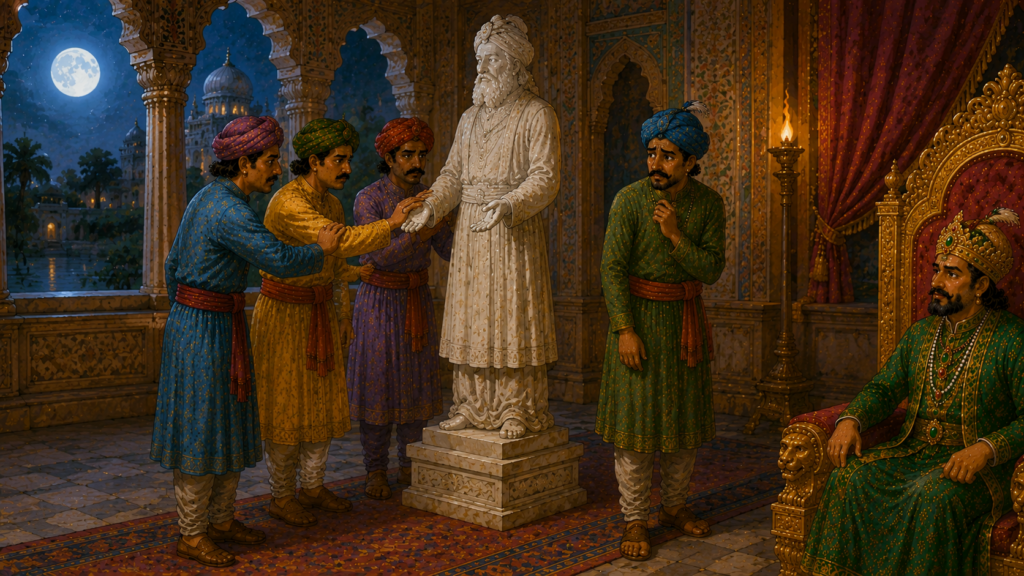
“What if the statue truly has magical powers?” he wondered.
“What if it identifies me?”
The more he thought, the more frightened he became.
The next morning, the four servants returned to court.
The entire palace was eager to hear the result.
Birbal stood beside the statue.
He looked at the servants and smiled.
“Now show me your hands.”
The servants stretched out their hands.
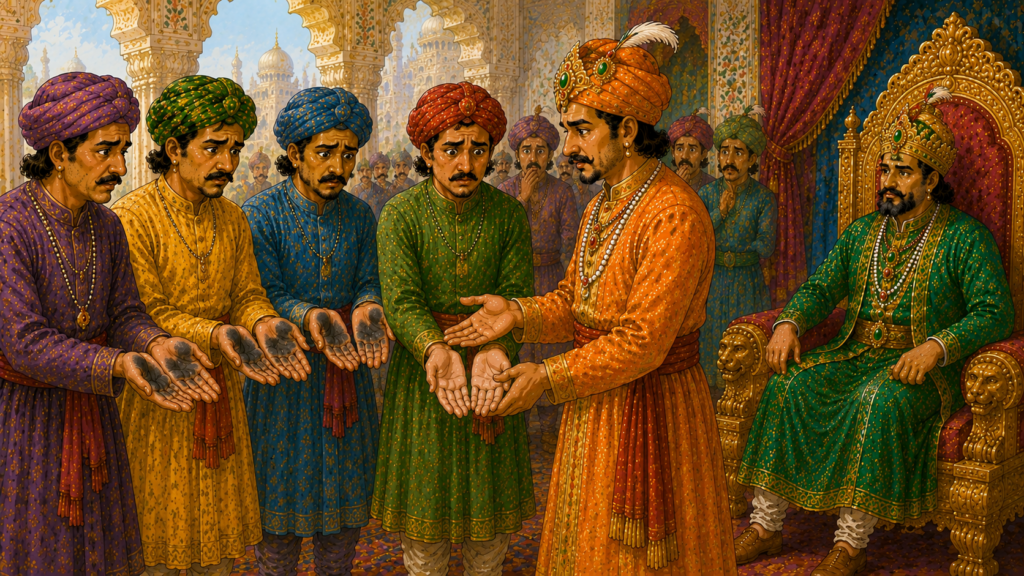
Birbal examined them carefully.
Three servants had black marks on their palms.
One servant’s hands were completely clean.
Birbal immediately pointed at him.
“You are the thief.”
The servant’s face turned pale.
“What? No! I am innocent!”
The court burst into whispers.
Akbar leaned forward.
“Explain, Birbal.”
Birbal smiled.
“The statue has no magical powers.”
Everyone looked surprised.
“The black powder on the statue’s hands rubbed onto anyone who touched it.”
The ministers nodded.
Birbal continued, “The innocent servants touched the statue because they had nothing to fear.”
He then pointed at the guilty servant.
“But this man was afraid the statue would reveal him. So he never touched it at all.”
The court gasped.
The servant began trembling.
His clean hands had exposed him.
Akbar spoke sternly.
“Tell the truth.”
The servant fell to his knees.
“Forgive me, Your Majesty!”
“You stole the necklace?” asked Akbar.
“Yes,” the servant admitted.
The merchant looked shocked.
“Where is it?”
The servant lowered his head.
“I hid it beneath a pile of firewood behind my house.”
Akbar immediately ordered the guards to retrieve it.
A short while later, the guards returned carrying the missing pearl necklace.
The merchant’s face lit up with joy.
“My necklace!”
He thanked the emperor and Birbal again and again.
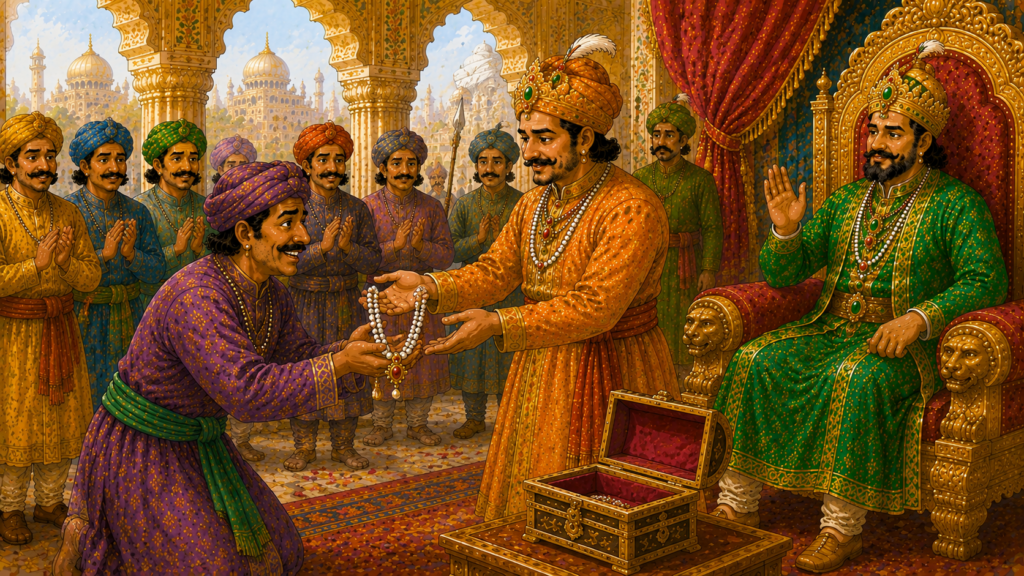
The court members applauded Birbal’s cleverness.
One minister said, “Birbal solved the mystery without even searching anyone.”
Another added, “Wisdom is more powerful than force.”
Akbar smiled proudly.
“Once again, Birbal has shown that intelligence is the greatest tool of justice.”
The thief looked ashamed.
“I thought I could escape punishment.”
Birbal replied kindly, “A dishonest person often becomes trapped by his own fear.”
The servant nodded sadly.
“I understand now.”
Akbar ordered a fair punishment according to the laws of the kingdom.
Before leaving, the merchant thanked Birbal once more.
The people of the kingdom spoke about the case for many years.
And everyone remembered the lesson of the foolish thief who believed he could hide the truth.
But in the end, his own fear revealed his crime.
Moral of the Story
Crime never pays. Wrong actions may seem successful at first, but they eventually bring trouble and punishment.
What Kids Learn
- Honesty is always the best choice.
- Fear often follows dishonest actions.
- Wisdom can solve difficult problems.
- Truth cannot stay hidden forever.
- Good character is more valuable than wealth.
- Actions have consequences.
Short Summary
A wealthy merchant’s pearl necklace is stolen, and four servants become suspects. Birbal creates a clever statue test and tells them that a magical statue can identify the thief. Secretly, he places black powder on the statue’s hands. The innocent servants touch it, but the guilty servant is too frightened and avoids touching it. His clean hands reveal the truth, and he confesses. The stolen necklace is recovered, teaching everyone that crime never pays.
FAQs
1. Who stole the pearl necklace?
One of the merchant’s servants secretly stole and hid the necklace.
2. How did Birbal catch the thief?
Birbal used a statue test with hidden charcoal powder to identify the guilty servant.
3. Was the statue really magical?
No. Birbal only pretended it was magical to make the thief reveal himself.
4. Why did the thief get caught?
He was afraid of being exposed and avoided touching the statue.
5. What is the moral of The Foolish Thief story?
Crime never pays, and dishonest actions eventually lead to trouble.
Read More Stories
Who is the Real Mother in English with Moral
Opening Introduction
Who is the Real Mother in English...
The Magic Stick in English with Moral is a famous-style Akbar and Birbal story that teaches children...
Many children enjoy listening to the Most Precious Thing story in English, a famous tale from Akbar and...
Many children love listening to the Birbal’s Wisdom Test story in English, one of the most interesting...
This is a famous Birbal clever answer story for kids in English with moral. It is an interesting Akbar...
This is a famous Birbal’s Khichdi story for kids in English with moral. It is a classic Akbar and Birbal...